
Alternate Self: Full Interpreted Story
This document steps outside of the narrative to examine what the story is intended to represent. While the Contiguous Story focuses on what the narrator experiences as events unfold, the Interpreted Story connects those events to their broader psychological, philosophical, and thematic meaning. It explains the significance of the characters, locations, objects, identities, conflicts, and recurring patterns that may not be fully understood by the narrator at the time they occur or ever fully explained from within the story.
The purpose of this document is not to replace the story with a single definitive explanation, but to provide a wider perspective on it based on what the author intended. It examines how each series connects to the others, why the narrator makes certain decisions, how their previous experiences influence later behavior, and what larger ideas emerge from the narrative as a whole. Where the Contiguous Story asks what it feels like to live through the journey, the Interpreted Story asks what that journey reveals when analyzed from outside of it.
See the Contiguous Story for a raw depiction of how the narrator actually experiences things as they happen.
And just so you’re not confused reading this: all characters go by they/them except the Spirit and Martyr who go by he/him and she/her respectively. These characters primarily represent philosophies and I didn’t feel the need to assign gender to any but two. It’s a little clunky and confusing, I’ll admit, but I don’t really see another solution because these characters aren’t even designed to be people, hence why they don’t have names, but titles.
ARC 1
SERIES 1: Noble
The Navigator: Fueled by Selflessness
A tale of how selflessness becomes corroded through the harshness of reality.
Series 1 explores how genuinely noble intentions can become destructive when they are pursued through inauthenticity. The Self begins with a sincere desire to improve their life and the lives of those around them, but comes to believe that the person they currently are is incapable of achieving those goals. The appearance of the Shimmer therefore represents both genuine inspiration and the beginning of a fundamental misguided decision: rather than becoming more secure in themselves, the Self decides they must become someone else to make their life better. Thus, the Navigator is born from the belief that self replacement is necessary for self improvement.
Initially, this choice does not appear harmful. The Navigator still believes in morality, still wants to help others, and still considers their intentions noble. However, they no longer trust their authentic self to accomplish these things. Becoming different while simultaneously becoming stronger, smarter, more successful, and more capable seems like a reasonable way to become a better person. The difference between changing oneself and abandoning oneself therefore becomes increasingly difficult to recognize, especially because this path is initially successful. The Navigator is genuinely achieving things that the Self struggled to achieve, thus their inauthenticity appears to be working.
This is what allows corruption to develop gradually. Success reinforces the belief that the Navigator is superior to the Self that came before, while the growing distance from authenticity makes it increasingly difficult to trust their own judgment. Moral decisions that once felt obvious begin requiring justification. Instead of recognizing this as a loss of integrity and morality, the Navigator interprets it as becoming realistic. The world is fundamentally harsh and they’re just being honest about that. Their morality increasingly becomes based on whether an action produces their desired result rather than whether it is something they genuinely believe is right.
The Navigator eventually reaches a crisis when they recognize that they are becoming increasingly successful while simultaneously becoming less empathetic and moral, and the whole point was to do both. However, rather than abandoning the path, they search for an explanation that will preserve their belief in it. This produces the revelation of Clarity: if the world rewards selfishness and punishes empathy, then morality must be an obstacle rather than a virtue. The Navigator can therefore resolve the contradiction without confronting the possibility that the path itself is flawed. Their insecurity disappears because they have found an explanation that makes their actions internally consistent.
From there, the Navigator’s original, justifiable purpose is gradually replaced by achievement itself. Helping others ceases to be the primary objective, while becoming better becomes an end in itself. Choosing oneself stops feeling like a decision and begins to feel like the only logical thing to do. Relationships deteriorate as others recognize the growing contradiction between who the Navigator claims to be and who they actually are. Instead of reflecting on this, the Navigator interprets their rejection as betrayal, reinforcing the belief that the world itself is responsible for their misery.
The tragedy of the Navigator is therefore not simply that they become selfish, it is that selfishness emerges from an attempt to remain selfless. They wanted to become more capable so they could build a better life and improve the lives of others, but because the pursuit was never rooted in an authentic understanding of themselves, every success pushed them further away from the values that originally made the pursuit meaningful. They allowed selfishness to thrive in the name of selflessness.
The Navigator ultimately achieves the Crown. Their success is real, their Legacy is real, and they have genuinely become more capable. Yet the relationships and values they were originally trying to improve have largely disappeared. The Crown therefore becomes proof that the Navigator’s philosophy worked externally while failing internally. They achieved what they wanted without obtaining what they actually needed.
By the end, the Navigator still cannot accept responsibility for this outcome. Because almost everything else improved, they conclude that other people must have prevented the life they envisioned from becoming reality. This allows the cycle to continue. Rather than returning to the Self and questioning the premise that created the Navigator, they recommit to becoming even stronger, smarter, and better. The Navigator therefore does not simply fail to escape the Alternate Self cycle, they voluntarily and consciously choose to deepen it.
Representations
The Navigator represents the first fully constructed Alternate Self: an idealized identity created to accomplish what the authentic Self believes they are incapable of accomplishing. The Navigator is initially motivated by selflessness, ambition, and a genuine desire to improve life for themselves and others. Their eventual corruption demonstrates that even noble virtues can become destructive when they are practiced without authenticity. The Navigator does not abandon morality because they stop caring, they abandon it because their morality becomes increasingly detached from who they actually are.
The Crown represents external success, accomplishment, recognition, and the belief that fulfillment exists somewhere beyond the current self. It functions as the ultimate justification for the Navigator’s transformation. Because the Navigator actually does achieve the Crown, it becomes difficult to argue that the path was simply ineffective, because it clearly wasn’t. However, external success cannot restore the authenticity sacrificed to obtain it, thus the Navigator still feels like they’re missing something, even as the Crown sits atop their head.
The Shimmer represents inspiration in its purest form but simultaneously the temptation contained within inspiration. It is the feeling that life could become dramatically better and that one’s potential is greater than one’s current circumstances suggest. Thus, the Navigator interprets that feeling as evidence that the current self must be replaced in order to get what they want. The Shimmer therefore represents both genuine hope and the beginning of self rejection.
The Arsenic Amulet represents the Navigator’s conscious commitment to becoming an Alternate Self. Wearing it signifies accepting the idea that authenticity is something that can be sacrificed in exchange for capability and success. Arsenic is valuable in appearance but poisonous, while an amulet is traditionally associated with protection. Together, they represent a philosophy that appears protective and empowering while gradually poisoning the identity it was meant to strengthen.
The Alternate Self cycle represents the recurring belief that personal problems can be solved through self replacement rather than self understanding. The cycle begins when the Self concludes that their authentic identity is the obstacle standing between them and fulfillment. Each Alternate Self can therefore appear to offer genuine progress, but only because it temporarily removes the insecurities and limitations associated with the previous identity. However, because the underlying problem remains unresolved, the new identity eventually becomes another source of conflict, requiring another transformation.
SERIES 2: Brawn
The Traitor: Fueled by Strength
A complete mental breakdown caused by discovering that strength cannot replace connection.
Where the Navigator was motivated by ambition, the Traitor is, rather predictably, motivated by betrayal, and converts that pain into a new philosophy. Series 2 examines what happens when a single irreducible wound (the inability to sustain genuine connection) gets rationalized into an entire worldview. The Traitor isn’t just bitter, they build an entire worldview around the bitterness and call it strength. Every value gets inverted: vulnerability becomes weakness, empathy becomes liability, and connection becomes the enemy. And that worldview works remarkably well for the Traitor. They become stronger, sharper, more accomplished, and more feared. The philosophy is genuinely effective at everything except the one thing it was designed to solve.
What the Traitor cannot see, and what the series gradually reveals, is that they are not operating independently of others at all. Every motivation remains defined by external forces, only now in hostile form. They crave challenges to prove others wrong. They break rules to force others to notice them. They become addicted to being doubted because overcoming doubt gives them purpose. The claimed independence is still dependence, just with the reasons reversed. The pursuit of infinite strength is impossible from the outset for exactly this reason: the stronger they become, the more they require enemies to justify that strength. Without conflict, the identity collapses. And so, even in peaceful times, the Traitor manufactures drama, conflict, and challenge simply to keep existing.
But underneath the escalating performance, someone sees through it and stays anyway. They match the Traitor in ways they didn’t think were possible and do not respond to any of their usual assumptions. For the first time, the Traitor is not merely chosen by someone else, they choose in return. They pursue this person, explain themselves, and make room for them inside a worldview that was built specifically to avoid needing anyone. For a brief period, something real exists, not necessarily admiration, not specifically alliance, but genuine recognition. The Traitor experiences the answer to a question they have been asking since Series 1: what would connection actually look like? And the answer terrifies them because they’ve been hiding their authentic self since the very start. The idea of someone seeing that is unacceptable.
Every tool the Traitor has built is designed for a world where connection is either impossible, dangerous, or temporary. They have no mechanism for accepting something that contradicts the philosophy that has organized their worldview and threatens their superiority. So they begin searching for reasons that the connection is insufficient. They reinterpret fear as standards, vulnerability as incompatibility, and uncertainty as clarity. Eventually, they make a choice: the worldview or the person. They choose their worldview.
There is no betrayal, no dramatic conflict, and no external force to blame, even in theory. The relationship ends because the Traitor voluntarily destroyed something they knew they wanted. This is their first loss that cannot be explained or even interpreted by hostility, misunderstanding, or the failures of others. It is a consequence of the Traitor’s own actions, and as much as they refuse to admit it, they know the difference.
This creates a problem unlike any previous wound. Betrayals could be converted into fuel because they reinforced the philosophy. This loss does the opposite by serving as evidence against the philosophy itself. The Traitor now possesses definitive proof that connection was possible for them, that it was desired by them, and yet that it was destroyed because of them. The worldview remains functional, but it has been internally contradicted, and the Traitor will eventually have no choice but to acknowledge that.
The later half of the series follows the Traitor’s attempts to escape this contradiction. The addiction to being doubted, the obsession with cruelty, and the performance of brazen detachment all continue, but they are now fueled by the knowledge of what was briefly possible and yet voluntarily sacrificed. The Traitor rewrites the story repeatedly to avoid the truth. Attachment becomes the enemy. Vulnerability becomes weakness. The person becomes incompatible. Anything is preferable to admitting the simpler truth: they chose the thing they claimed to want least over the thing they actually wanted most.
By the end of the series, the worldview has begun to hollow from within. The Traitor sees themselves clearly enough to understand that strength could never eliminate vulnerability, only postpone confronting it. The performance that once felt like freedom increasingly resembles a prison maintained by habit and fear. The series does not end with redemption, but with the first true crack in the foundation: the realization that the greatest opponent remaining is not the outside world, but the self that resentment built. That self cannot defeat itself using the same resentment that created it. Something else will eventually have to emerge to do so, though the Traitor does not yet know what that is, and would not support it even if they did.
Representations
The Traitor represents resentment converted into identity. Unlike the Navigator, who sacrificed authenticity in pursuit of connection, the Traitor deliberately dismantles empathy in pursuit of invulnerability. They embody the belief that strength alone can eliminate suffering while becoming defined entirely by the people they claim no longer matter. The more they succeed at not needing anyone, the more their identity ironically depends on having someone to not need.
The cloak and mask represent the transformation of a coping mechanism into identity. Initially protective, a way to project superiority rather than expose loneliness and their authentic self, the disguise eventually ceases to conceal anything and becomes the only self that remains. The Traitor believed so strongly in the idea that they were something they weren’t, despite actively being confronted with evidence that they weren’t, and despite knowing it was not who they were or who they wanted to be, that the cloak and mask become their only sense of self, therefore impossible to abandon without losing direction entirely.
The crowns, carried over from Series 1, mean something different in Series 2. Where the Navigator pursued the crown as a symbol of earned recognition, the Traitor accumulates crowns as substitutes for the one thing recognition was always a proxy for. Each crown confirms the philosophy and deepens the void simultaneously. They are proof that the system works and evidence that the system was never solving the right problem.
The unnamed presence in the middle of the series represents the answer to the question the Traitor has been asking since Series 1: what would connection actually look like? Unlike previous relationships, this one is not defined by betrayal, conflict, or misunderstanding, it exists specifically to confront the Traitor with the possibility that their philosophy may be incomplete. This person sees through the performance and stays anyway. More importantly, the Traitor chooses them in return. They pursue them, explain themselves to them, and make room for them inside a worldview built to avoid dependence. For a brief period, the Traitor experiences exactly what they claimed was impossible: genuine recognition without hostility. And because that’s supposed to be impossible, the Traitor destroys the relationship out of fear.
Previous wounds could at least theoretically be attributed to others, to betrayal, or to the cruelty of the world, but this loss cannot, not even in the slightest. The Traitor chooses to end it because accepting it would require questioning the identity they have built around strength, resentment, and self sufficiency, and that vulnerability terrifies them. The unnamed presence therefore represents proof that the Traitor’s worldview was never entirely true. Its loss becomes the central contradiction of the series. The Traitor had the thing they wanted, knew they wanted it, and chose against it anyway because they weren’t ready to be honest or vulnerable. Everything that happens in the series is a messy and internally contradictory attempt to explain away that knowledge, but being ultimately unsuccessful.
SERIES 3: Truth
The Nameless: Fueled by Truth
A story about overcoming conflicting and misguided ideas with a determination to find self and truth.
Series 3 marks the first time the Self stops trying to construct a better version of themselves and instead begins questioning the entire system that led to the creation of the Navigator and Traitor. After the acceptance of the fact that the Traitor’s worldview cannot provide what the Self actually wants, the internal world begins to collapse. Rather than immediately replacing that worldview with another, the Self sits with the discomfort and allows themselves to think through what has happened. This period of darkness represents the beginning of genuine introspection: there is no immediate answer, only the growing realization that the problem cannot be solved by creating another identity.
The Traitor remains present, but their influence has changed. The Self can now recognize the Traitor’s thoughts as something separate from their own, creating distance between the individual and the identity that previously controlled them. However, understanding a destructive worldview does not immediately eliminate its influence. The Traitor still offers certainty, strength, and a familiar way of interpreting reality, and the Self remains tempted by those things. In response, the Self awakens the Navigator to oppose the Traitor. For a moment, this seems like the obvious solution: if the two identities can fight and one can finally defeat the other, perhaps the Self can discover which philosophy was correct all along.
Instead, their conflict exposes the inadequacy of both. The Navigator understands exactly why the Traitor exists and offers them forgiveness, but the Traitor rejects this because they do not want to be treated as something broken, they want to be challenged, which the Navigator agreed to do earlier. The Navigator’s willingness to forgive therefore becomes another form of failure because neither identity knows how to genuinely engage with the other and neither identity can accept their own flaws. Their battle becomes a clash between two incompatible answers to the same underlying desperation, with neither capable of providing a satisfying way forward.
This realization is what allows the Self to intervene. The important discovery is no longer that one identity is better than the other, but that neither of them contain the correct way to live. The Navigator cannot provide everything the Self wants, and neither can the Traitor. Both are rigid and absolute responses to a complicated reality, and both have become too invested in their own philosophies to change. The Self, however, can change because they are the one who created them. The question therefore shifts from “which identity should control me?” to “how do I put my authentic self back in control?” For the first time since The Shimmer, the Self wants to be themselves.
The Nameless emerges from this realization. Unlike the Navigator and Traitor, the Nameless is not another idealized answer to the problem. Its defining characteristic is the refusal to provide one. The Nameless embraces uncertainty, inconsistency, and the possibility of simply being a mess without knowing exactly where things are going. This works and is liberating because the previous identities were built around certainty and control, thus exposing those concepts as nonexistent causes them to lose that certainty and control. For the first time, the Self does not need to know exactly who they are before they are allowed to exist.
This willingness to accept uncertainty also changes how the Self views the past. The Navigator and Traitor were not created because the Self was inherently selfish, malicious, or incapable of knowing better, they were created during periods of desperation, when becoming someone else seemed like the only way to obtain any semblance of prosperity, when the decisions were still made from insecurity. The Self can finally recognize that the decisions that created them came from a person who was trying to survive circumstances they did not understand. This does not excuse what those identities eventually did, but it means the Self no longer needs to hate the person who created them. This allows the Self to become comfortable in authenticity.
The internal conflict therefore changes from determining which identity deserves to win into understanding why either identity needed to exist at all. The Navigator and Traitor remain dangerous because they still want control, but their influence begins to weaken once the Self stops treating their philosophies as absolute truths. The Nameless does not defeat them by becoming stronger than them in the traditional sense, but by making their apparent certainty irrelevant.
The final internal battle represents this distinction. Truth exposes the contradictions that allowed the Navigator and Traitor to maintain control, certainty collapses when confronted with inconsistency, and control loses its purpose when the Self values freedom instead. The Navigator fades, the Traitor falls, and even the Nameless surrenders to the authentic Self. This is not a triumphant destruction of three enemies so much as the end of their necessity. They were never truly separate people, but ways the Self learned to survive. Once their purpose has been understood, they no longer need to determine who the Self is.
For the first time, the Self can look backward without seeing only failure. They remember the person who existed before the identities: someone paradoxical and mysterious, intensely driven and ambitious, but also genuinely noble and well intentioned. That person was not simply destroyed by the world, they also made choices that allowed their goodness to become corrupted. They wanted connection while refusing to prioritize anyone over themselves. They wanted the best for themselves while believing their current self was inadequate. Understanding these contradictions is important because the Self no longer needs to simplify the past into a single explanation. They can finally just see themselves honestly without being afraid of that.
That honest understanding becomes the foundation for moving forward. The Self does not emerge from Series 3 with a completed identity or a perfect philosophy, rather, they emerge with the ability to exist within uncertainty without immediately replacing it with another fabricated self. The storm has ended, but the clouds remain. The Self now understands where they thrive and how they can search for who they are without abandoning themselves in the process. The series therefore ends with the Self not needing to become someone else to continue forward. They can remain unfinished, contradictory, uncertain, and imperfect while still moving toward something better. But one final obstacle remains. The identities have been dismantled, yet the insecurity that made them appealing in the first place has not disappeared. The Self recognizes that confronting it will require surviving one final internal storm. If not defeated, the cycle will continue.
Representations
The Self represents the authentic individual beneath every constructed identity. Unlike the Navigator and Traitor, the Self is not defined by a single worldview or set of absolute beliefs. The Self existed before the identities were constructed and gradually regains control by understanding why those identities were created rather than simply trying to replace them.
The Nameless represents the rejection of identity as a solution to internal conflict. It is intentionally undefined because defining itself too rigidly would simply recreate the same problem in another form. Its willingness to be uncertain, inconsistent, and incomplete allows the Self to escape the demand that they must always know exactly who they are.
The Navigator and Traitor represent two opposing but equally incomplete philosophies. The Navigator believes that selflessness, improvement, and idealism can provide the answer, while the Traitor believes that selfishness, ruthlessness, and rejection of morality are necessary for success. Their conflict demonstrates that neither philosophy is sufficient because both attempt to impose a simple answer onto a complicated reality. Their eventual disappearance represents the Self no longer needing either worldview to determine how they live.
The sledgehammer, the Nameless’s weaponry, represents truth as a force of demolition rather than construction. It is not used to build a new identity, it is used to destroy the false foundations that the previous identities were built upon. However, destroying the Navigator and Traitor leaves the Self without a fully defined identity, meaning Series 3 ends with freedom, but not authentic identity, since there is no identity left. The Self has cleared away the false structures, but is a blank slate and must now personally determine what, if anything, they genuinely want to build, and has to address the root problem behind the creation of the Navigator and Traitor if they want to remain free: insecurity.
The Arsenic Amulet represents the Self’s complicated relationship with the identities that came before. The Self now understands that the Alternate Self cycle was destructive, but also understands that the Navigator and Traitor originated from genuine desperation rather than meaningless failure. Putting the Amulet back on at the end therefore does not represent returning to ignorance, rather it is a conscious decision to draw upon the strength associated with those identities while remaining aware of what they are. The Self knows the cycle exists, knows what it has cost, and still believes some of that strength is necessary for the final confrontation with insecurity. It represents unfinished growth: awareness has been achieved, but complete freedom has not.
ARC 2
SERIES 4: Doubt
The Matador: Fueled by Intelligence
A battle between intelligence and insecurity alongside a memoir of adopting courage.
Series 4 marks the beginning of the Self’s attempt to confront the root of the problems that created the Alternate Self cycle and with the primary motivation to put an end to said cycle. After dismantling the Navigator and Traitor in Series 3, the Self recognizes that simply understanding the identities they created is not enough. Beneath both personas was a much larger problem: insecurity. Rather than constructing another identity to compensate for it, the Self must finally confront the feeling of inadequacy that made becoming someone else so appealing in the first place. The journey therefore becomes less about discovering which version of the Self is correct and more about learning to exist without needing a version at all.
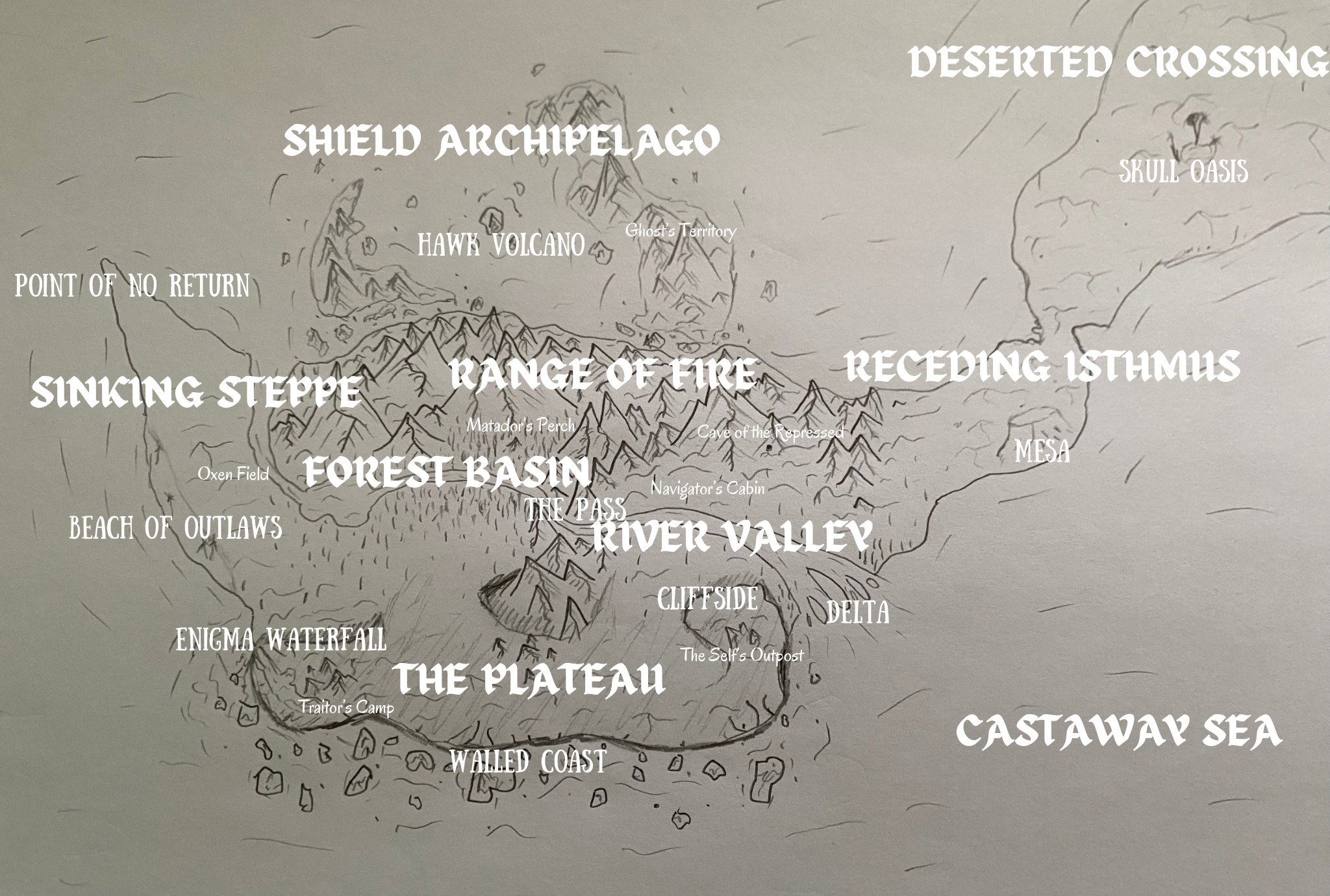
This is also the first series in which the geography of the peninsula becomes explicitly relevant. Series 1-3 take place primarily within the Plateau and River Valley, while Series 4 moves through the Forest Basin, Sinking Steppe, and eventually returns to the Plateau. The changing geography reflects the Self moving into previously unexplored regions of their internal world.
The Self begins the series believing that insecurity is simply another enemy that must eventually be defeated. This assumption initially causes them to approach the conflict in familiar terms: identify the problem, understand it, develop the correct strategy, and overcome it. Intelligence, represented by the Matador, becomes the primary tool for this process. However, the series gradually reveals that intelligence cannot solve everything by itself. Understanding a problem and even understanding how to solve it does not automatically give someone the courage to act, nor does identifying the source of insecurity make the underlying feelings disappear.
The Matador serves as the Self’s first true ally within this new conflict. Unlike the Navigator, Traitor, and Nameless, they are not another version of the Self attempting to take control. They represent intelligence as a tool for understanding rather than domination, operating independently of the Self. Their opponent, the Ox, represents insecurity, while the Horde represents the countless doubts and secondary thoughts produced by that insecurity. The resulting conflict is therefore fundamentally different from the internal wars of the previous series. The Self is not fighting another philosophy, but the emotional foundation that allowed those philosophies to exist.
The early portion of the series explores the remaining assumptions that could allow the Alternate Self cycle to continue. The Self first questions whether an “actual self” even exists, since people naturally change throughout their lives. This argument briefly threatens to invalidate everything learned in Series 3: perhaps becoming someone else was never the problem because there is no permanent identity to betray. However, the Self ultimately recognizes the distinction between authentic change and compensatory transformation. Identities naturally develop and change, but the Alternate Self cycle was not simply the result of growth, it was repeatedly driven by feelings of inadequacy and the desire to escape the current Self.
This realization leads directly into a deeper crisis: the Self no longer knows what they actually want. Previous identities always supplied an answer. The Navigator wanted the Crown. The Traitor wanted more. The Nameless wanted freedom from the entire conflict. But now the Self must determine their desires without relying on a constructed identity to provide them. This uncertainty gives insecurity an opportunity to attack, producing reasons why the Self could never obtain what they want and encouraging them to distrust their own judgment and worth.
For a brief period, identifying these desires restores a sense of purpose. Yet that purpose quickly becomes complicated when the list of desires grows into impossible demands. The Self begins recognizing that even their genuine wants can become another source of pressure if they are treated as requirements that must or can all be satisfied. At the same time, their growing understanding of the Ox’s behavior allows them to temporarily stand their ground against insecurity, demonstrating that understanding does provide real strength even if it does not immediately produce victory.
That progress is then interrupted by the realization that the world owes the Self nothing for their efforts. Understanding themselves does not erase their past. Becoming better does not guarantee compensation. Their previous actions still carry guilt and consequence, and the Self explicitly rejects the idea that they are entitled to redemption simply because they now understand what went wrong. Their goal is not to prove themselves worthy of forgiveness, but to regain control over their own life. This realization causes their motivation to collapse just as the Ox calls in the Horde, overwhelming them once again.
The Self eventually realizes that there are three possible ways to respond to insecurity: fight it directly, flee from it, or allow it to run its course. The Matador finally reaches them and initially provides enough support for the Self to fight alongside them. But exhaustion and diminished morale eventually force the Self to retreat. When the Horde pursues them, the Self surrenders rather than continuing to fight or flee. Surprisingly, the Horde refuses to attack. This becomes an important turning point because it allows the Self to enter the deeper reaches of their mind and examine the burdens beneath the Ox rather than continuing to treat insecurity exclusively as an opponent.
The Self then begins examining the internal conditions that allowed the Alternate Self cycle to begin. They confront their complicated relationship with other people and the paradoxes that have repeatedly frustrated their emotional wellbeing. Instead of immediately trying to resolve those contradictions, they allow themselves to actually experience them. This represents a significant departure from their previous behavior. Throughout the Alternate Self cycle, confusion demanded an answer, pain demanded suppression, and inadequacy demanded replacement. Here, the Self deliberately refuses to respond that way.
They apply the same approach to their perception of the modern world. The Self recognizes genuine frustration, greed, poor decisions, and broader problems that contribute to an increasingly pessimistic view of life, while also recognizing that these issues are too complicated to simply solve through personal willpower. Rather than turning this realization into another absolute worldview, the Self allows the contradictions to exist. The goal is no longer to find an answer that eliminates discomfort, but to understand their own perspective without allowing it to consume them.
This process eventually leads to the deepest layer of insecurity: fragile self worth. The Alternate Self cycle had protected the Self from confronting this directly by continually providing someone else to become. Every identity created distance from the person who felt inadequate. By finally confronting the underlying insecurity, the Self begins understanding why the cycle was so compelling in the first place. The realization is painful, but it gives them something previous identities never could: an explanation for why they kept needing to become someone else.
The destruction of the Arsenic Amulet marks the definitive rejection of that cycle. The Amulet had carried the Self through the Navigator, Traitor, and Nameless identities, making it a physical representation of the power and temptation of becoming someone else. Destroying it therefore means more than abandoning the pain of the past, it means accepting that the Self can no longer borrow another identity whenever being themselves becomes frightening or painful. The Amulet, alongside the Nameless’s sledgehammer and armor all disintegrate together, leaving the Self without the tools that previously allowed them to construct and inhabit alternate versions of themselves. The Self replaces the Nameless, and for the first time the temptation of the cycle itself is gone.
With the Amulet destroyed, intelligence produces another breakthrough: there is no single philosophy capable of explaining how everyone should live. Different philosophies can work for different people under different circumstances without being universally correct or incorrect. This frees the Self from the same absolutism that previously created their identities. They no longer need to find the philosophy that will finally explain their failures or guarantee their success, they must instead develop an approach that actually works for them specifically.
This realization gives the Self an unexpected sense of strength despite having lost every weapon they previously relied upon. The Horde can no longer overwhelm them in the same way because the Self has stopped treating each individual doubt as something that must be defeated through force. The Horde is destroyed, and the Self returns to the Matador and Ox having gained a more stable understanding of themselves. They embrace their contradictory nature without turning that contradiction into another commitment or identity. They can contain strengths and weaknesses, past and future, and conflicting desires without needing to make every part of themselves agree.
After the Matador and Self cause the Ox to retreat, The Self then apologizes for the mistakes they have made. These apologies are not presented as a means of erasing guilt or guaranteeing forgiveness, rather they represent an acceptance of responsibility without allowing guilt to become another form of paralysis. Most significantly, the Self recognizes that their actions nearly killed the Matador and apologizes to them directly. The Matador forgives them despite the Self believing they do not deserve it, reinforcing the idea that accountability does not require self destruction.
Intelligence’s final breakthrough is curiosity. Rather than treating life as a problem that must eventually be solved, the Self learns to approach it with curiosity. Curiosity does not demand certainty, perfection, or immediate resolution. It allows the Self to encounter the world, other people, systems, and even their own mind without immediately turning every observation into a judgment or absolute answer. This becomes the final philosophical development necessary before courage can emerge.
The Matador then reveals the sword of Courage, embedded within a stone. Intelligence cannot remove it without damaging the blade, only the Self possesses the strength necessary to pull it free. This establishes the fundamental limitation of intelligence. Understanding can reveal what needs to change, but it cannot make the final decision to act. Courage must ultimately come from the individual themselves.
The Self finally confronts the central realization of the series: wanting to become somebody else and believing they do not want the best for themselves are connected. The desire to become someone else was what allowed the Self to define their current identity as the problem. Once that assumption existed, sacrificing values, relationships, and integrity could all be reframed as improvement. Now, having traced insecurity back to its roots, the Self is capable of confronting and admitting the idea directly rather than building another identity around it or being ashamed by it.
When the Ox returns, the Matador buys the Self enough time to pull the sword from the stone. The Self claims Courage and becomes the Spirit. The green light and reflection of his eyes establish courage as the defining characteristic of this new identity. Unlike the previous Alternate Selves, the Spirit emerges from confronting and understanding the Self rather than escaping it. Yet the distinction is deliberately unstable: the Spirit is still an identity, a tool for solving a specific problem, and therefore potentially another attachment.
This appears contradictory, so let me explain: the Self becomes the Spirit because, at this moment, courage is not experienced as an imposed ideal or an escape from inadequacy, rather it feels like the clearest expression of who they have finally discovered themselves to be. The Self wholeheartedly believes that the Spirit is an authentic extension of themselves, not someone constructed to replace weakness, but the person who emerges when insecurity is no longer allowed to dictate what is possible for them. Yet this belief is precisely where the ambiguity lies. The Spirit may be rooted in authenticity, but he is not necessarily identical to it, he is still an interpretation of the Self, emphasizing one discovered quality and allowing that quality to become central to how they understand themselves. The Self does not consciously construct the Spirit as another Alternate Self, because they genuinely believe they have finally found who they are, which was one of the priorities for them in Series 4. But believing wholeheartedly that one has discovered one’s true identity does not necessarily mean that identity is the complete truth. In this sense, the Spirit represents the distinction between who the Self actually is and who they sincerely believe themselves to be. By all definitions, he is not a continuation of the Alternate Self cycle, but in practice, he may as well be.
The Spirit then defeats the Ox, but the victory comes at the cost of the Matador’s life. The Matador’s final warning establishes the unresolved problem that will carry forward: “Before long, you must return the sword, or else you will become it.” Courage has allowed the Self to become the Spirit and defeat insecurity, but the warning suggests that even courage can become dangerous if it stops being a tool and becomes another absolute answer, even if it is rooted in authenticity.
The series ends in apparent triumph. The Spirit feels victorious, free from the identities that once controlled them, and ready to return to the external world. He buries the Matador, recognizing the role they played without needing an object or identity (like the Amulet) to preserve their memory. He burns the Ox’s body so that they cannot retake control, while still feeling some sympathy for them. The Spirit then discovers the Matador’s insignia engraved upon the sword, realizing that the Matador deliberately placed it in the stone for them to find. Although he does not understand this reasoning, he accepts the warning that the sword must eventually be returned.
For the first time since Series 1, the Spirit begins walking toward the isthmus and the outside world. But this time, he is simply returning to life as himself. Yet the confidence that the internal struggle is finally over is intentionally premature. The internal world has stabilized, but the Spirit is still thinking through what comes next. The storm has ended, but the story has not.
Representations
The Self represents the authentic individual rebuilding their life by dismantling the Alternate Self cycle and pursuing authenticity directly. Unlike the previous personas, the Self is not defined by a single philosophy or desired trait. They are capable of contradiction, uncertainty, growth, and change without needing those qualities to become another identity.
The Matador represents intelligence, but specifically intelligence used for understanding rather than superiority or control. They are the first ally rather than another identity, guiding the Self toward increasingly difficult realizations. Their eventual death demonstrates that intelligence can bring someone to the threshold of courage but cannot cross it for them.
The Ox represents insecurity. Unlike the Navigator, Traitor, and Nameless, the Ox is not a philosophy or constructed identity. It is a more primitive emotional force that generates feelings of inadequacy and attacks the Self’s ability to trust their own judgment. The existence of the Ox is why the Alternate Self cycle began in the first place, as the feelings of inadequacy it produced is what caused the Self to replace themselves with the Navigator.
The Horde represents doubt: the multitude of secondary thoughts, rationalizations, fears, and self criticisms generated by insecurity. Individually they can be overcome, but collectively they become overwhelming when the underlying insecurity remains untouched.
The peninsula represents the Self’s internal world. The geography becomes increasingly important because the Self is now entering previously unexplored areas of their own mind. The Forest Basin, Sinking Steppe, Plateau, and other regions therefore function as psychological spaces rather than merely physical locations.
The Arsenic Amulet represents the final remnant of the Alternate Self cycle. Destroying it marks the moment the Self consciously rejects the belief that suffering can be solved by becoming somebody else. Its destruction also distinguishes Series 4 from the previous series: the solution is no longer another transformation.
The sledgehammer represents the truth driven destruction of the previous identities. Its disappearance alongside the Amulet signifies that the Self no longer needs the tools that once allowed them to dismantle or control their fabricated identities because there is no longer a fabricated identity in control.
The sword represents courage. Unlike intelligence, courage does not provide an answer or guarantee certainty. It allows the Self to act despite uncertainty. The fact that the Self must physically pull it from the stone establishes that courage cannot simply be given to them by the Matador, it must ultimately be claimed through their own strength.
The Spirit represents the Self after adopting courage as their defining characteristic. He is the first identity that emerges from genuine integration rather than inadequacy, but he remains an identity nonetheless. The Matador’s final warning therefore establishes the central unresolved danger: even a virtue discovered authentically can become another prison if the Self mistakes it for their entire identity.
SERIES 5: Valor
The Spirit: Fueled by Courage
A futile war against ego, a realization of impossible dreams, and a refusal to accept peace.
Series 5 is fundamentally different from everything that came before it. It is less a story about defeating a monster or an inauthentic self than it is about reaching the limits of a philosophy that has defined an entire life. It asks the question of what it would look like to remain true to oneself even if one’s current, authentic identity no longer provides what they want. The Spirit begins convinced they have finally overcome every internal obstacle that once held them back. Returning to the world is supposed to mark the beginning of a new life, but instead he discovers that understanding himself does not automatically mean understanding other people. Throughout the first quarter of the story, he repeatedly faces the unpredictability of human relationships, conflicting emotions, social expectations, and the impossibility of reducing people to systems and logic. Every failed interaction reinforces a worldview that has already served him well: identify the source of suffering, remove it completely, and life improves. Every series that came before implies that this exact approach actually worked against previous aspects of the self, represented by the death of figures like the Navigator, Traitor, and Ox. Because of those successes, the Spirit’s increasingly absolute thinking is not simply stubbornness, but the result of experience. He has been rewarded for decisive action before, so when another problem appears, he naturally assumes the answer is to eliminate it as well.
That being said, the Spirit does not return to the world believing he has abandoned everything he learned in Series 3 and 4. Quite the opposite: he believes he has finally integrated those lessons. He has learned to value authenticity, reject replacement identities, examine problems at their roots, accept uncertainty, and act with courage even when afraid. When the outside world begins presenting him with problems that do not reward those principles as cleanly as his past experiences did, he does not immediately conclude that his philosophy is wrong, rather he assumes he simply has not understood the problem yet. His frustration therefore comes partly from genuine confusion: he finally believes he knows how to approach life, only to discover that life refuses to behave like the internal problems he spent years solving. Thus, he reaches for the lessons learned in Series 4. Faced with people who naturally refuse to operate on logic, he spends the first quarter of the series doing exactly what worked against insecurity: stepping back, searching for patterns, and trying to understand the root instead of overpowering it. But even in Series 4, understanding a problem was still a means to eventually resolving it. With people, and later the Ghost, understanding is a lot more difficult, and the removal of the problem is explicitly impossible, which is why the Spirit becomes so frustrated. When patience and analysis fails to produce an answer, the Spirit isn’t abandoning what he learned before, so much as discovering it is incomplete, even though it worked against the Ox. As a result, the Spirit returns to the only strategy left in his history that has ever reliably ended a conflict: confrontation and removal. So the Spirit’s absolutism isn’t a betrayal of his character, it’s the last tool he has that he knows has worked before, and he’s trying as hard as he can to remain true to himself. To the Spirit, his regression feels like consistency. Each step feels justified by something he has learned earlier, which means he keeps carrying conclusions from one context into another where those conclusions no longer apply.
The appearance of the Ghost changes the story because it is fundamentally unlike every previous character. It is introduced as seemingly just another external threat, but gradually becomes clear to be something much different. Unlike the other identities, the Ghost cannot be harmed, cannot be permanently defeated, immediately regenerates from every injury, never speaks, and never fully explains its intentions. It behaves more like a force of nature than a person. The Martyr eventually reveals that all of the major characters are aspects of the same mind, forcing both the Spirit and the reader to reinterpret everything that has happened. Rather than literal deaths, the destruction of earlier characters represented the abandonment of previous identities or worldviews. The Ghost, however, is not an identity or worldview, which is why it is effectively invincible. The story deliberately refuses to define exactly what it represents, but everything about its behavior suggests that it is something fundamental to being human, perhaps desire, instinct, unconscious motivation, attachment, or some irreducible psychological force. This would explain why it alone cannot “die” while every other character can. You can change beliefs, abandon identities, or outgrow coping mechanisms, but you cannot simply remove whatever underlying process gives rise to wanting, fearing, or acting in the first place. The Ghost’s regeneration visually expresses this idea: every attempt to destroy it only recreates it, because the Spirit is trying to eliminate something that is part of his biology.
The Spirit initially has no reason to understand any of this. From his perspective, the Ghost simply appears as a threat. It attacks him first, survives attacks that should have killed it, and continues interfering with his ability to live on his own terms. The discovery that it consumes the stars then makes the situation even more personal: the Spirit realizes that whatever this thing is, it appears to be connected to the very desires that brought him to the Shimmer in the first place. For someone who has spent four previous Series trying to understand why his life went wrong and continues to, this discovery changes everything. He finally believes he has found the hidden cause behind his suffering. If the Ghost helped create the desires that created and sustained the Alternate Self cycle, then killing it seems like the ultimate act of self liberation, which is exactly what the Spirit is now prioritizing.
The conflict with the Ghost also mirrors the Spirit’s earlier struggle with the external world. At the beginning of the series, he becomes increasingly frustrated that people, relationships, and society refuse to conform to the logical, authentic life he envisioned. Returning to the peninsula does not solve this frustration, it merely shifts it inward in the form of the Ghost. The Ghost becomes another reality that refuses to bend to the Spirit’s ideals, forcing him into the same pattern of thinking he had already applied to the outside world. In both cases, he becomes convinced that peace lies just beyond the removal of one final obstacle, whether that obstacle is an incompatible world or an uncontrollable part of himself. The Ghost therefore does not introduce a new conflict so much as reveal that the Spirit has been approaching every conflict through the same underlying philosophy all along, despite it no longer working.
This creates the story’s central philosophical conflict: The Spirit, ignoring the Matador’s warning, believes freedom means complete sovereignty over the self, and uses the sword as a means to those ends. Every external influence, every imposed desire, and every uncontrollable force represents a threat to true independence. His repeated declarations about controlling the peninsula, refusing peace, and rejecting compromise all stem from this desire for absolute agency. Meanwhile, the Martyr presents a fundamentally different philosophy. She does not argue that the Ghost is good, nor does she suggest surrendering to it. Instead, she insists that coexistence is the only possible form of peace specifically because the Ghost cannot be removed. Her role is therefore not to defeat either side, but to reconcile them. The Spirit rejects this completely because accepting coexistence feels indistinguishable from accepting defeat. His previous victories taught him that removing the source of suffering was always the correct solution, so the Martyr’s advice sounds like abandoning the strategy that has already transformed his life for the better. Furthermore, the Spirit resists being convinced to change. He is the first identity deliberately built on authenticity and is unwilling to betray himself, to a fault. Neither philosophy is presented as obviously correct or foolish. In fact, the Spirit’s confidence is understandable precisely because the story demonstrates in earlier Series that his worldview has repeatedly produced genuine growth, so abandoning it, even when his approach has yet to work, and even when this particular problem is fundamentally different than the ones he has solved before, feels like a betrayal of the authentic self he just fought so hard to obtain. This is significant because, regardless of whether the Martyr is part of the Alternate Self cycle or not, this is the very first time the Spirit has refused to become somebody else in order to solve his problems. It is proof that the Alternate Self cycle is in fact over, but that the Spirit still cannot adapt to the problems that caused the cycle to exist in the first place.
This also explains why the Martyr’s proposal is so threatening to him. The Spirit spent Series 3 learning that the solution is not to become another person, but to embrace his messy and uncertain self. He spent Series 4 destroying the Amulet and battling the Ox precisely because he no longer wanted to run from himself. Now the Martyr asks him to accept something he desperately wants gone. To the Spirit, this feels dangerously similar to the surrender he spent the previous Series literally fighting against. If he cannot remove the Ghost, and if he simply has to live alongside it, then what was the point of all that struggle? What was the point of becoming the Spirit at all? The possibility that courage might mean continuing to live alongside something he cannot defeat is almost incomprehensible to him, because courage has always meant acting despite fear, not accepting the thing causing it.
The Spirit’s psychological decline unfolds gradually, but similar to Series 2, he does, eventually and indisputably, become the villain of the story, however understandable or justified his character is. At first he remains hopeful, believing the right solution simply has not been found yet. But frustration turns into withdrawal, withdrawal becomes purposelessness, purposelessness becomes obsession, and obsession eventually collapses into violence. His thinking narrows track by track until every situation appears to contain only two possible outcomes: authenticity or conformity, control or subjugation, victory or defeat, kill or be killed. By the time he encounters the Martyr, he has already spent most of his existence (including earlier Series) interpreting every conflict through this binary framework, making compromise psychologically impossible. This progression makes the murder of the Martyr the story’s most significant moment. On the surface, it’s shocking because she is the only character sincerely trying to help, but in retrospect, it follows naturally from everything that came before. Throughout Series 5, the Spirit repeatedly insists he has never been the aggressor, and in a narrow sense this is true, every Series that came before is the Self trying to defend themselves. However, in every Series that came before, they chose escalation rather than de-escalation, and inevitably in Series 5 he ends up crossing the line into becoming the clear aggressor himself by killing the only person peacefully offering another path. The Martyr’s name becomes appropriate, as she dies because she refuses to compromise the very philosophy she represents, mirroring the Spirit’s own dedication to his, and mirroring the very same disagreements the Navigator and Traitor had, just in a new form and context.
The murder is not simply because the Spirit “becomes evil.” It is the moment when his commitment to authenticity becomes indistinguishable from his commitment to being right. He cannot tolerate the possibility that another person might genuinely understand something about his situation that he does not because he has spent this long fighting for himself. How could anyone else possibly understand his situation? That possibility would force him to admit that his own philosophy has a boundary even if it has served him well. Except, this is the first true boundary he has encountered, so naturally he defends his position. Killing the Martyr allows him to preserve his philosophy and avoid admission of incompleteness, at least temporarily. In that sense, he destroys not merely a person, but the possibility of having to reconsider himself. Because why would he? Is that not who he has been fighting for?
Reflecting on all that’s happened, when the Self becomes the Spirit in Series 4, the very first thing the Spirit does is kill the Ox. Yes, the Ox was a genuine threat who had just killed his ally, the Matador, but still, the Spirit’s very first action is violence. But this violence is not exclusive to the Spirit. When the Self resurfaces in Series 3, their very first intentions are to slay the Navigator and Traitor and to retake control. While many would argue that these intentions and actions are justified in isolation, it still produces a character that defaults to absolute solutions whenever things aren’t going his way, it’s just that those absolute solutions have worked and have been justified, all up until now. The murder of the Martyr is the first objectively unjust act of violence he commits, but everything he has done in the past leads up to this moment. At every opportunity, regardless of how just their actions were, the Self and Spirit have chosen escalation. Thus, naturally, when the Martyr suggests an alternative path, and when she refuses to enable the Spirit on his current path, he lashes out. It’s sad, it’s disappointing, and it’s unjust, but it makes sense given the journey this character has been on.
Even after all of this, the Spirit genuinely believes he is still protecting himself. Even when he kills the Martyr, he does not experience the act internally as “I have decided to hurt someone.” He experiences it as the final consequence of someone standing between him and what he believes he must do. This is precisely how his previous absolutism functioned: the thing that obstructed the goal became the thing that had to be removed. The difference is that, this time, the obstacle is another person who is trying to help him, but he doesn’t see that difference. The Spirit has crossed a line without ever consciously deciding to abandon his principles, which is what makes the murder tragic, because on some level, it made sense, even if it was totally unjustified. It’s exactly what he has done and what has worked every other time. So why would he question it?
However, this moment is still fundamentally different from the Spirit’s earlier acts of violence because almost immediately, he realizes that something has gone catastrophically wrong. For perhaps the first time in the entire story, the person obstructing him is removed, except this time he confronts the possibility that they were not actually the problem. The Martyr’s death does not strengthen his conviction, it exposes the horrifying reality of what his conviction has allowed him to become. He recognizes that he has become the villain again, not necessarily because someone else betrayed him or forced him into a corner, but because he made a choice that he himself can no longer justify. This realization does not redeem him, nor does his regret excuse the consequences of what he has done, but it’s a perspective he has never adopted before. Rather than immediately constructing another explanation, another enemy, or another identity to protect himself from the consequences, the Spirit finally begins listening to the Martyr. Slowly, and only after she is already gone, he begins processing what she had been trying to tell him. Her death by his hand forces him to acknowledge the reality of his situation in a way that no previous conflict could. The same person who had spent his entire existence fighting desperately to preserve himself is now confronted with the possibility that he has become precisely what he spent every previous Series trying not to become because of that preservation. It is this recognition that leads him toward the decision to end himself because of his guilt, which no previous version of himself would have even considered. The murder is therefore not simply the end of his refusal to listen, but the event that finally forces him to listen. He cannot undo what he has done, but for the first time, he consciously recognizes his mistake and begins taking steps, however imperfectly, toward accepting the truth of it rather than escalating further. Just like the end of Series 2, this is not change, but something has changed.
The ending intentionally refuses to provide a complete resolution. The Spirit never accepts the Martyr’s perspective, never reconciles with the Ghost, and never truly understands what the Ghost is. Instead, he leaves the peninsula entirely, building the boat and sailing toward the distant glimmer. This is significant because it is neither conquest nor surrender, while also echoing the Shimmer. It is a familiar adaptation for this character for when he has lost everything else. The final line, “If the world is chaos, and if my mind is a prison, I will work around both,” captures both the growth and the limitation of the Spirit’s journey. He has finally abandoned the impossible goal of destroying the Ghost, but has not accepted its existence either. Rather than resolving the conflict, he chooses to navigate around it. Whether this represents genuine healing, avoidance, the beginning of a new stage of growth, or simply another coping strategy remains intentionally unclear, as the Spirit himself does not know. Likewise, the story leaves several important questions unanswered: the Ghost’s precise nature, whether the Martyr’s philosophy would actually have succeeded, whether the Spirit’s absolutism is ultimately a flaw or simply a once-successful strategy meeting its first unsolvable problem, and what the distant glimmer truly represents, because their answers don’t change the point of the story. Rather than arguing for a single psychological or philosophical conclusion, Series 5 examines what happens when someone who has survived by relentlessly conquering every obstacle finally encounters things that cannot be conquered, both internally and externally, forcing them to confront the possibility that not every battle can be won, and that control is not always possible.
The Spirit finally stops trying to destroy the Ghost. But he does so only after exhausting every other possibility, and he still frames the solution in terms of working around the problem rather than accepting it. This is why the ending echoes the Shimmer. The Shimmer promised a new life if he became someone else while the glimmer promises a new life if he can simply go somewhere else. The mechanism has changed, but the instinct is identical: if the present configuration of life cannot give him what he wants, perhaps another configuration can. The difference is that this time he does not need to become someone else to leave. He takes himself with him, but goes somewhere else instead. Even though the Alternate Self cycle is over, the instinct is still there, and that’s what Series 5 demonstrates through the actions of the Spirit. He believed his growth was done, and everything that happened in the Series demonstrates that belief was wrong.
Representations
The Spirit now represents courage taken to its logical extreme. Having successfully overcome previous internal struggles, the Spirit believes every problem can be solved through sufficient determination and decisive action. Their greatest strength gradually becomes their greatest limitation, as courage slowly transforms into absolutism. Still, courage itself is not the mistake. Courage allowed the Spirit to defeat the Ox. It helped him survive the Matador’s death, destroy the Amulet, and move forward without the identities that once controlled him. It was the underlying driving force between the return of the Self entirely and only became conscious with the creation of the Spirit. The problem is the assumption that because courage worked before, it must remain the correct response to every future problem. The Spirit turns not an identity, but a virtue into a universal methodology, exactly what the Navigator did, just under vastly different circumstances. He doesn’t need to replace himself to repeat the same mistakes.
The Ghost is intentionally left ambiguous, but it appears to represent an irreducible aspect of human psychology rather than another identity. Whether interpreted as ego, desire, instinct, unconscious motivation, attachment, or some combination of these, its defining characteristic is permanence. Unlike previous personas, it cannot be destroyed because it is not something the mind creates, but something the mind necessarily contains. Its regeneration symbolizes the futility of attempting to eliminate structural aspects of being human. Furthermore, the Spirit’s discovery of the Ghost impacting his desires feels like finally finding the missing explanation of his entire life. That makes his obsession with destroying it understandable: he believes he has finally located the mechanism behind the suffering that began the entire journey, even independent of the Ox. Yet the Ghost’s permanence suggests that this premise is flawed. There may never have been a single thing responsible for everything, clearly the Ox was still involved, and maybe there are dozens of other Ghosts hiding in the mountains that the Spirit just hasn’t found yet. The Spirit doesn’t actually know, he’s just making an educated guess based on pattern recognition. Furthermore, the Spirit can’t actually prove that the Ghost was influencing his desires in the first place. Again, it’s a well educated guess, but the Spirit is still the one to chase the glimmer at the end, and the Ghost had no direct influence on that desire or decision. The reality may be far more complex than the Spirit gives it credit for.
The Martyr represents acceptance, integration, and reconciliation. Rather than advocating for surrender, she argues that peace requires coexistence with aspects of oneself that cannot be removed. Her death illustrates the cost of rejecting compromise entirely, both by herself and the Spirit, while her title reflects her willingness to die rather than abandon the philosophy she embodies, similar to the Spirit. Therefore, she is not simply “the correct answer.” The story never explicitly proves that her approach would have worked. What she represents is the possibility that coexistence may be necessary, not necessarily correct, precisely because some problems cannot be solved. The Spirit cannot accept that possibility because doing so would require sacrificing his belief that every meaningful problem has a solution, even if difficult to find.
Ultimately, what the Spirit, Ghost, and Martyr represent is slightly up to interpretation by design because they’re not symbols (like the characters in earlier Series were), they’re concepts. The Ghost represents whatever weakness or problem within yourself you can’t quite fix, regardless of what it is and regardless of why it’s there. The Spirit represents how you respond to that and how you cling to old methods for one reason or another. The Martyr represents the only reasonable way out that requires sacrificing something you don’t want to sacrifice. So you’re stuck between something you can’t fix and can’t accept, and only one of those states can be changed. It’s a difficult and frustrating psychological position to be in, and that’s what Series 5 is about. There’s no clean answer, you just have to choose what you’re willing to sacrifice.
The sunset symbolizes the collapse of certainty. As daylight fades, so too does the Spirit’s confidence that previous victories have solved life’s deeper problems. It marks the transition from a world where obstacles appear understandable into one dominated by ambiguity and unfamiliarity, causing the Spirit to double down on the one thing he has left: his courage, which itself works very well in unfamiliar situations, but sometimes it alone is not enough.
The eruption mirrors the Spirit’s emotional state. Just as the volcano violently releases internal pressure while the battle continues uninterrupted, the Spirit’s accumulated frustration finally bursts outward without resolving his conflict with the Ghost or the world. It demonstrates that emotional release alone does not necessarily produce clarity or healing.
The stars represent guiding ideals, aspirations, and sources of meaning, while deliberately being similar to the Shimmer. The Ghost’s consumption of them visually suggests that the Spirit’s motivations are influenced by unconscious forces they do not fully understand, and that the Alternate Self cycle was started partially by the Ghost acting in the background of the Self. As the stars disappear, the Spirit loses direction, confidence, and patience simultaneously, reinforcing the fear that even personal desires may not truly belong to him, and forcing him to reconcile with what he truly is, a question he thought he had already answered. He had destroyed the Alternate Selves, reclaimed the Self, overcome insecurity, and embraced the courage that was always present. The possibility that something deeper may have influenced his desires all along threatens the stability of that achievement. If even his desires are partly outside his conscious control, then the absolute self sovereignty he has been fighting for may be impossible.
The glimmer serves as an inversion of the original Shimmer. Where the Shimmer inspired transformation into someone else, the distant glimmer offers hope without requiring self replacement. It remains intentionally ambiguous, functioning less as a destination and more as the possibility that another way of living exists beyond the conflict consuming the peninsula. Yet its existence and the Spirit’s chase for it represent that the Spirit’s understanding of himself and the Ghost is flawed and that he is not done with growth, which he believed himself to be, since he is still following the familiar adaptation that led to the creation of the Alternate Self cycle. In response to overwhelming circumstances, this time he doesn’t replace himself, but he does replace his surroundings. It represents that the most accurate answer to the Shimmer might be that the Self, Ox, and Ghost all simultaneously wanted it, rather than any one of them alone being exclusively responsible for it.
The peninsula continues to symbolize the mind, but now takes on another meaning: perceived total control. The Spirit repeatedly seeks complete sovereignty over the peninsula, equating psychological freedom with absolute mastery over every aspect of the self. Leaving it therefore symbolizes abandoning the belief that complete internal control is achievable.
The sea represents uncertainty beyond the boundaries of self understanding. Unlike the mapped peninsula, it is open, undefined, and impossible to fully control. Choosing to sail into it, even without having much of a choice, reflects a shift away from conquest toward adaptation, even if the Spirit has not fully embraced acceptance. It is the very first hint we get that the Spirit is truly adapting, and it is the very last thing that happens in Series 5.
The sword continues to represent courage, but its meaning evolves. Earlier it was the means of overcoming insecurity, now it becomes the instrument through which the Spirit attempts to solve an unsolvable problem. It demonstrates that even virtues are context dependent. A tool capable of defeating one obstacle may become ineffective, or even harmful, when applied indiscriminately to another.
The repeated references to obsidian represent the Spirit’s absolute philosophy hardening as his struggles increasingly try to turn him away from it. Obsidian forms when previously pressured molten rock cools too quickly to develop flexible internal structure, mirroring the Spirit’s refusal to slowly process experiences that challenge his worldview. As the series progresses through imagery of silica, pressure, magma, eruption, lava flow, rapid cooling, and solidification, the Spirit’s thinking follows the exact same transformation in the same order. What begins as a fluid philosophy capable of curiosity gradually solidifies into something sharp and powerful, but ultimately rigid and brittle. By the end of the story, obsidian symbolizes courage that has crystallized into uncompromising certainty, making adaptation psychologically impossible until that certainty inevitably shatters.
Firebending and waterbending represent opposing approaches to psychological conflict. Fire embodies willpower, action, determination, passion, and direct confrontation, the Spirit’s preferred way of engaging obstacles. Water represents adaptability, patience, restoration, and coexistence, embodied by the Martyr. Neither element is portrayed as inherently superior, instead, the story suggests that relying exclusively on one inevitably creates imbalance. The inability of fire alone to defeat the Ghost reinforces the central theme that not every problem yields to force, just as water alone could never have defeated the Ox in Series 4. There is not one philosophy or approach that is “right” or “wrong.” The Spirit needed the courage of fire to defeat the Ox because the Ox was something he could and needed to overcome. But he encounters the Ghost after he has already internalized that victory as evidence that decisive action is fundamentally reliable. Series 5 is what happens when the lesson from Series 4 meets an exception. The Spirit cannot recognize the exception until he has already destroyed nearly everything around him trying to show him that said exception does, in fact, exist.
SERIES 6: Peace
The Martyr: Fueled by Peace
A series of attempts towards acceptance and the shedding of emotional burdens.
TBD
Full Story
The overall story is divided into two arcs. The first arc, Series 1 through 3, is about construction and deconstruction: building identities, discovering they don’t work, and tearing them down. The second arc, Series 4 through 6, is about breaking that cycle and learning to live with what remains. The end of Series 3 sets them apart, where the Self re-emerges with full awareness of the cycle but no real idea what to do about it. Everything before that point is the problem being defined. Everything after is the attempt to resolve it.
Within the first arc, Series 1 and 2 mirror each other almost perfectly in structure while traveling in opposite directions. Series 1 begins with genuine hope and ends in bitterness. Series 2 begins in bitterness and ends with the first honest crack in its own foundation. They are the same story told forward and backward, arriving at the same recognition from opposite sides: that neither selflessness nor strength can solve the underlying wound. The difference is what each series costs. Series 1 costs the Self their values and their original sense of purpose. Series 2 costs them the genuine connection they almost had, and unlike the betrayals they’re used to, this loss is certifiably their own fault. That distinction makes Series 2 irreversible in a way Series 1 wasn’t. The Navigator could at least theoretically blame others. The Traitor cannot, even if they try.
They also mirror each other in their relationship to other people. The Navigator performs selflessness for others and loses themselves in the process. The Traitor performs indifference to others and also loses themself in the process. Both series are about being entirely defined by external forces. The Navigator needs others to validate their nobility. The Traitor needs others to doubt them, oppose them, and eventually leave so they have something to convert into fuel. Neither are independent, despite believing themselves to be.
Series 3 stands apart from this mirror structure because its job is transitional. It exists to dismantle what Series 1 and 2 built and clear the ground for the second arc. The entire series is internal: the Navigator and Traitor battle each other as competing philosophies, and the Self wins not by choosing between them, but by seeing through both. The Nameless is the only persona in the entire story designed to disappear once their purpose is complete. Every other identity clings to control. The Nameless lets go willingly, which is why they’re the only one that actually succeeds on their own terms. Their purpose is transitional, and once the truth has been uncovered, they step aside. That willingness to disappear is what separates genuine clarity from another form of compensation.
The second arc begins with Series 4, continuing the internal conflict that began in Series 3. Except, this time, the conflict is no longer between constructed personas, but between the Self and emotional forces that were never personas to begin with. The Ox and the Horde aren’t identities or worldviews, they’re insecurity and doubt operating below the level of philosophy. For the first time, the Self’s primary tool is not strength, defiance, or the deconstruction of false beliefs, but examination. They have to stop fighting long enough to actually feel what’s been driving everything. This reframing of what it means to engage with a problem is the central contribution of Series 4 to the overall arc, and it’s what makes the second arc feel fundamentally different from the first even though both involve constant conflict.
Series 4 and 5 are the sharpest mirror in the story because every variable inverts. The Self grows steadily across Series 4 while the Spirit decays steadily across Series 5. The Matador is sought and found through genuine collaboration while the Martyr descends uninvited and unwanted. The Ox represents insecurity traced to its root and can (theoretically) be eliminated. The Ghost represents something irreducible that cannot be eliminated, only coexisted with. The Matador dies as an unintended sacrifice because the Self couldn’t protect them in time. The Martyr dies as a direct and intended consequence of the Spirit’s own hand. The Ox is defeated. The Ghost walks away unharmed. Series 4 ends in genuine triumph despite real loss because the Spirit believes the worst is finally behind him. Series 5 ends with escape and devastation after the Spirit has eliminated the only person offering him a solution. Every win in Series 4 was real but incomplete. Every loss in Series 5 is real but instructive in ways the Spirit couldn’t access yet. Series 4 gives the Self everything he thought he needed and it still isn’t enough. Series 5 takes everything away and forces him to acknowledge what he actually needed. The Spirit’s ascent and collapse are products of exactly the same operating philosophy applied to problems it was and wasn’t designed to solve.
Series 5 and 6 mirror each other in approach rather than structure. Series 5 is defined entirely by the Spirit’s inability to accept anything he didn’t conquer. He fights the Ghost every time they meet, kills the Martyr rather than hear her out, and flees the peninsula rather than coexist with what he can’t defeat. Series 6 inverts all three of those responses without inverting the character. The Spirit and Ghost’s first nighttime encounter after the cave ends without a fight, not because the Spirit has surrendered, but because something has genuinely changed in how he operates. The Martyr’s words make sense and are embraced in the cave. The peninsula is returned to rather than fled from. Same character, same Ghost, same fundamental tension, but completely different set of choices.
Series 2 and 5 also mirror each other as the story’s two monster peaks. Both are series where the protagonist most fully becomes the villain and is aware of it throughout. The Traitor builds a structure around their monsterhood and calls it strength, knowing that it’s hollow. The Spirit’s decline is more violent, but equally self aware: he knows killing the Martyr is wrong yet does it anyway. Both series end not with defeat or victory, but with understanding: the Traitor realizing their philosophy is incomplete and the Spirit staring at the Martyr’s body before fleeing. They only differ in consequence. The Traitor’s monsterhood costs them an unnamed possibility that could have interrupted the cycle while the Spirit’s monsterhood costs him the only person who understood what the cycle actually was and how to survive it.
Series 3 and 6 mirror each other as the story’s two integration points. Series 3 is where the fragmented personas are first acknowledged as parts of the same person rather than enemies to be defeated: the Self sees the Navigator and Traitor clearly enough to step past both of them. Series 6 is where that acknowledgment becomes emotionally processed rather than just intellectually understood. The cave functions in both: in Series 3 as the place where the Self was buried and suppressed, in Series 6 as the place where the Spirit finally encounters the full accumulation of everything the cycle produced and stops trying to fight his way through it. Series 3 names the problem and clears enough ground to begin solving it. Series 6 doesn’t fully solve the problem but demonstrates it can be lived with without being destroyed by it.
Series 6 is also the only series titled after a character who is already dead. Every previous series introduced a new identity as its protagonist, but Series 6 doesn’t. The Spirit becomes the Self again during the Series because the work of Series 6 isn’t the construction of another identity, it’s the first time in the entire story that the Self simply exists without a persona. The Martyr fuels the series while not even being in it because her philosophy finally has room to be understood now that the Spirit has exhausted every alternative. In this context, she was right.
The story goes full circle between Series 1 and Series 6. Series 1 is a person choosing to be good and finding that goodness alone isn’t enough, which sets the entire cycle in motion. The Shimmer that opens Series 1 is the Self chasing a light on the horizon, believing it will make them into someone capable of getting what they need. Series 6 ends with the Self sailing away from that same light on the horizon, now behind them instead of ahead. They didn’t catch it and didn’t give up on it, but just stopped organizing their entire existence around the pursuit of it, which is the only true resolution this story was ever going to honestly reach.
Alternate Self is a story about one person’s lifelong struggle to sustain genuine connection. Everything that happens across six series, every persona, every battle, and every ally gained and lost is a response to that wound and an attempt to solve it. The Navigator tries to earn connection through selflessness. The Traitor tries to make connection irrelevant through strength. The Nameless tries to find a self that could actually connect. The Matador tries to heal what makes connection so difficult. The Spirit tries to conquer everything that stands between himself and the life he wants. None of them fully succeed, because none of them are wrong exactly, they’re each the right tool for a specific problem, applied to a problem that’s larger than any single tool can handle.
The Alternate Self cycle isn’t presented as something the protagonist should have escaped sooner or avoided entirely. Each persona was a genuine response to actual circumstances, and each one produced growth alongside damage. The Navigator’s ambition was real, the Traitor’s resilience was real, the Nameless’s clarity was real, the Matador’s wisdom was real, and the Spirit’s courage was real. These identities were not exclusively counterproductive, but each one was mistaken for the whole self rather than recognized as one part of it. The Arsenic Amulet is the story’s symbol for this mistake: something that strengthens while simultaneously eroding, valuable and poisonous at the same time.
The Ghost represents the parts of us that cannot be controlled or defeated because they aren’t beliefs or coping mechanisms, but part of who we are. It’s the natural final enemy of the Alternate Self cycle. The Spirit spends an entire series trying to kill it and can’t. He tries to flee it and it’s there when he returns. The resolution of the story doesn’t defeat or even fully understand the Ghost, but that the Self finally stops treating its existence as a problem to be solved and starts treating it as a fact to be lived with. It does not advocate for peace as the absence of conflict, but peace as the willingness to share territory with something you’ll never fully control, and to adapt anyway.
The story ends where it began: with the Self, alone, moving toward something they don’t yet understand, except everything else is different. The person who chased the Shimmer was running toward a light they believed would transform them into someone capable of getting what they needed. The Self who sails away from the Shimmer isn’t chasing anything and is sailing into open waters. They’re carrying everything the cycle made them, the Navigator’s selflessness and ambition, the Traitor’s bitterness and resilience, the Nameless’s understanding and messiness, the Matador’s intelligence and overreliance on analyzation, the Spirit’s courage and rigidity, the Martyr’s wisdom and acceptance, the Ox’s fear and growth through fear, and the Ghost’s immutability and desires, and moving forward anyway. They haven’t found a solution. They didn’t get what they wanted. But moving forward is what they do, and for the first time, that’s enough to sustain them, whatever the future brings.